Dedicated Development Teams: How to Ship Faster Without the Hiring Wait
When does a dedicated development team make sense, how does it compare to hiring or freelancers, and how do you set one up so it actually delivers?
Your roadmap is full. Your team isn’t growing fast enough.
Most growing companies know this situation. The product roadmap gets longer every quarter, customers ask for new features, and someone in management wants “something with AI” by next spring. Meanwhile, the development team is busy keeping the existing system running.
The obvious answer is to hire. But finding, interviewing and onboarding a senior developer can take months — and every week of delay is a week your competitors are shipping.
A dedicated development team is one way out of this trap. In this article we explain when it makes sense, how it compares to hiring or freelancers, and how to set one up so it actually delivers.
When a dedicated team makes sense
A dedicated team is a group of developers (and often a designer or QA engineer) who work only on your product, inside your processes, for months rather than for a single task. It is not the right answer for everything. It works best in these situations:
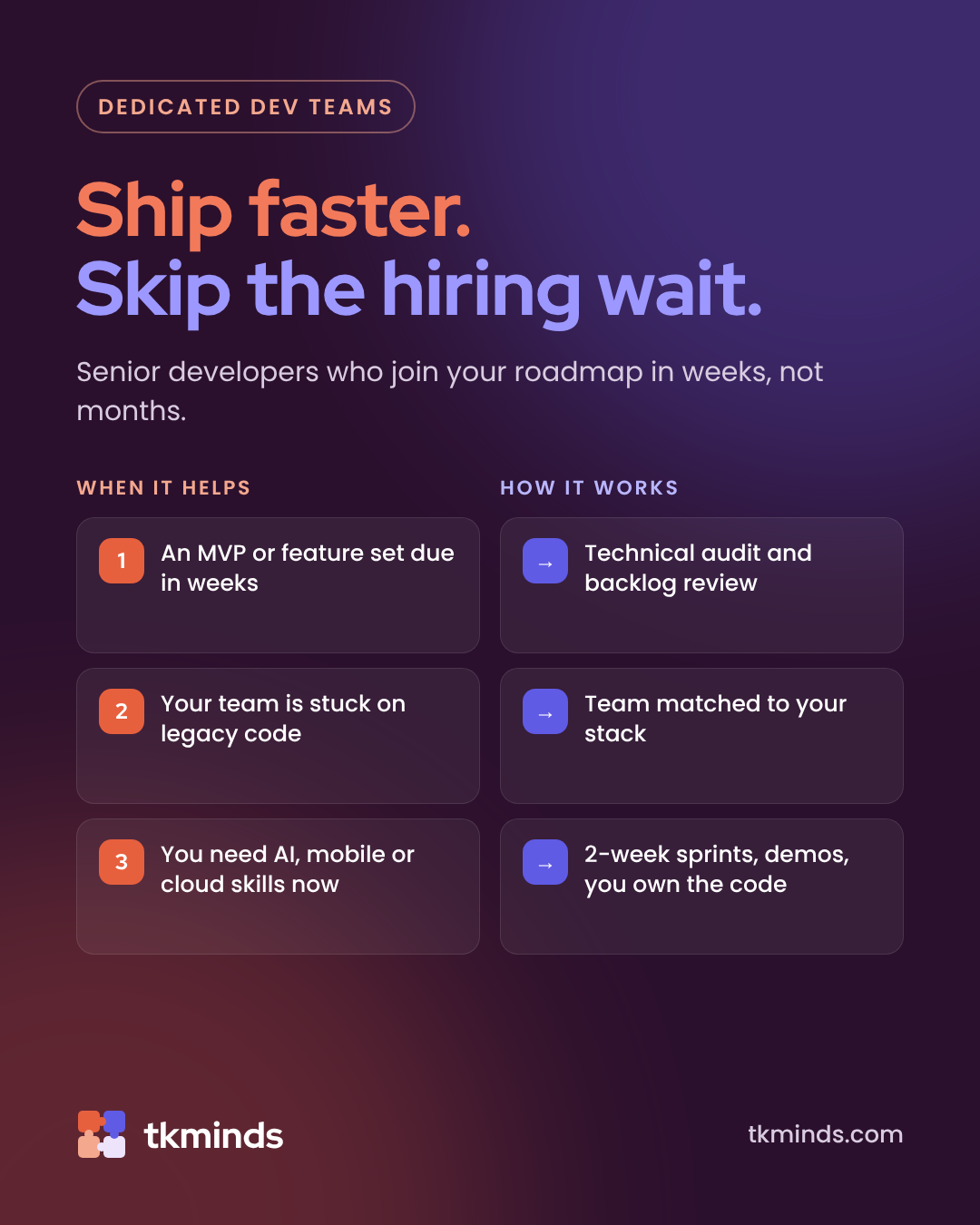
- You need to ship an MVP or a new product line in weeks, not quarters. A ready-made team that has worked together before can start delivering in the first sprint.
- Your in-house team is stuck maintaining legacy code. A dedicated team can take over new development — or the legacy work — so your core team can focus.
- You need skills you don’t have yet. AI integration, mobile apps, cloud migration: building that expertise from scratch takes time. Borrowing it gets you moving now.
- Your workload goes up and down. You can scale a dedicated team up for a big release and back down afterwards, without layoffs.
It is usually not the right choice if your project is a one-week fix, or if nobody on your side has time to set priorities and review the work.
Hiring vs. freelancers vs. a dedicated team
Each option has its place. The question is which one fits your timeline, budget and how much management time you have.
| In-house hire | Freelancers | Dedicated team | |
|---|---|---|---|
| Time to start | Months (search, notice periods, onboarding) | Days to weeks | Typically 2–4 weeks |
| Commitment | Long-term employment | Per task or short contract | Monthly, scalable up or down |
| Team coordination | Your managers | You coordinate each person | One point of contact, team already works together |
| Knowledge retention | High | Low — leaves with the freelancer | Medium to high, with good documentation |
| Best for | Core, long-term roles | Small, well-defined tasks | Products, MVPs and roadmaps that need steady delivery |
Many companies end up with a mix: a small in-house core that owns the product, plus a dedicated team that adds capacity and specialist skills.
How to set up a dedicated team so it works
The difference between a dedicated team that delivers and one that drains budget is almost always in the setup. These five steps make the difference:
- Start with a technical audit. Before anyone writes code, review the current system, the backlog and the documentation. This shows what the team actually needs to know — and often uncovers quick wins.
- Define what “done” means. Agree on priorities, acceptance criteria and the first three months of goals. A team without clear outcomes will stay busy without moving the business forward.
- Match the team to your stack. React, Node.js, Python, Flutter, cloud — the team should fit the technology you already use, not the other way around.
- Work in short sprints with demos. Two-week sprints with a demo at the end of each give you visible progress and the chance to change direction cheaply.
- Keep ownership on your side. Your repositories, your cloud accounts, your documentation. The code you pay for should always belong to you.
Common pitfalls to avoid
- Choosing on hourly rate alone. A cheaper team that needs twice the time and three rounds of rework is not cheaper.
- No product owner on your side. Someone in your company must set priorities and answer questions within a day. Without that, even a great team waits.
- The black box. If you only see the result at the end, problems surface too late. Insist on a shared board, regular demos and access to the code.
- Skipping documentation. Knowledge that lives only in developers’ heads leaves when they do. Make documentation part of “done”.
- Treating the team as outsiders. Invite them to planning, give them context about customers and goals. Teams that understand the “why” make better decisions.
How we work at TkMinds
At TkMinds we provide dedicated development teams for companies that need to move faster on software, AI and automation — without a long recruitment cycle.
- A short technical audit of your system and backlog before we start
- A team matched to your stack: React, Node.js, Python, Flutter, WordPress and AI integrations
- Two-week sprints with demos and transparent reporting
- One point of contact who speaks both business and engineering
- Full ownership of code, repositories and documentation stays with you
We used the same approach to build HR360, an HR platform with its own AI assistant, EVE — from discovery workshops to MVP to iterative releases.
Planning a product, an MVP or an AI project and short on developers?
Book a free 15-minute call and we’ll tell you honestly whether a dedicated team is the right fit.